Blog StreamPush is a YouTube Live verified encoder
YouTube has reviewed StreamPush and added it to its official list of verified live encoders. Here's what verification is, what YouTube checks, and what it means for running always-on channels.
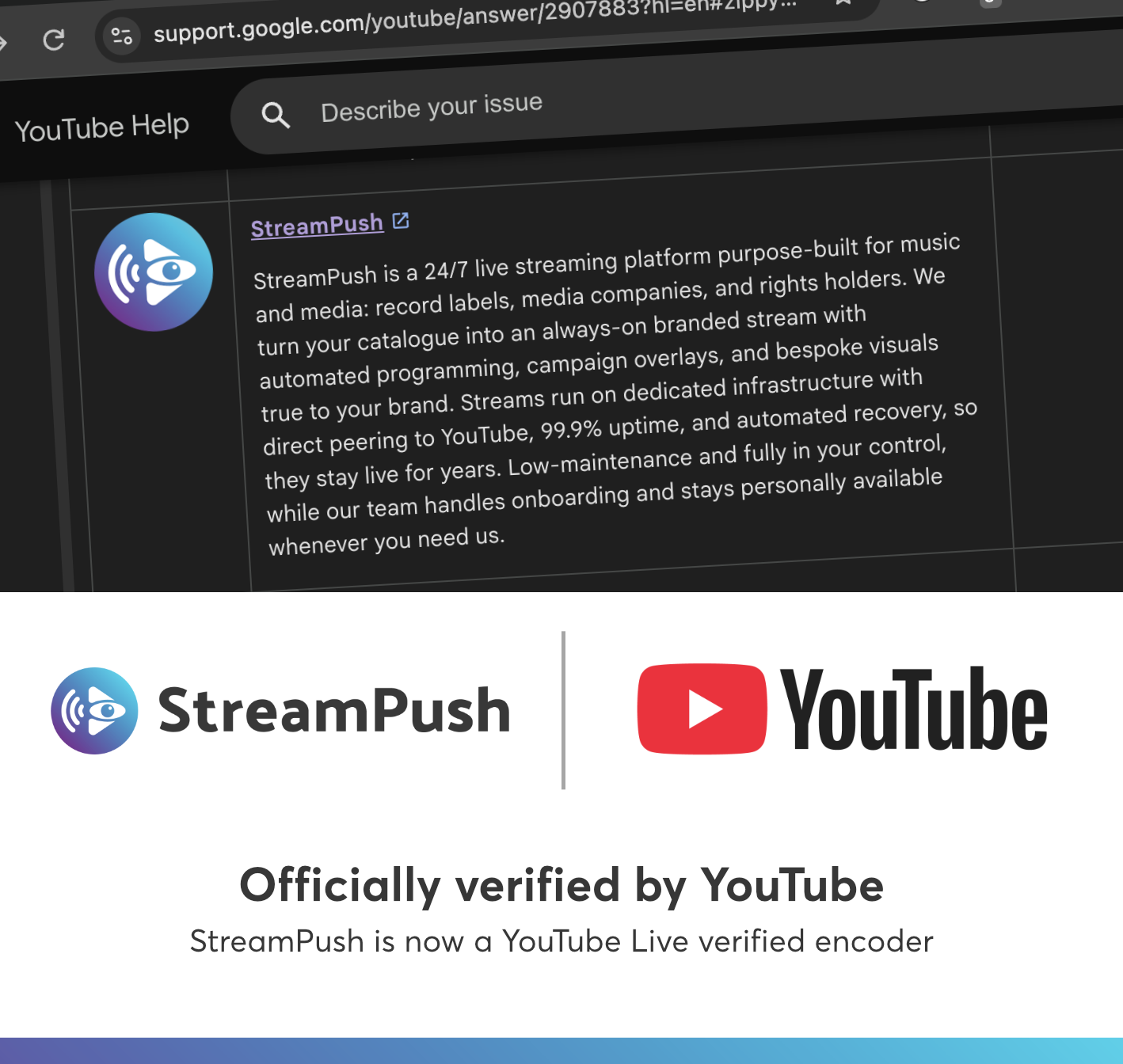
We're proud to share that StreamPush is now a YouTube Live verified encoder. YouTube reviewed how our platform works with theirs, approved it, and added StreamPush to its official list of verified encoders, next to AWS Elemental, OBS, Nvidia and Blackmagic Design.
For us, this is a real milestone. It's YouTube's official seal of approval on the part of StreamPush we care about most, which is keeping channels live for months and years without anyone having to watch over them.
What YouTube Live verification is
You don't need a verified encoder to go live on YouTube. Pretty much any software that can send a stream to a stream key will get a broadcast on screen. Verification is a separate program, and its purpose is confidence: content owners should be able to trust that the technology they choose will perform consistently every time it delivers a live stream to YouTube.
That makes it a different level from "Developed with YouTube", a label any product that uses YouTube's API can carry. Verification involves manual reviews and product checks by YouTube itself. The verification prerequisites are public and fairly detailed. A verified encoder manages broadcasts through the YouTube Live Streaming API, connects channels through Google's own sign-in, encodes every stream to YouTube's live encoding standards, and identifies itself to YouTube by name and version. Broadcasters have to be able to start and stop a stream without ever opening YouTube's Live Control Room. YouTube also reserves the right to limit how many products it certifies, so a place on the list isn't a given.

Stability and reliability, checked by YouTube
The requirement that matters most for a 24/7 channel is about what happens when something goes wrong. Connections drop now and then (a network hiccup, an ingest server that hangs up, a short outage somewhere along the route). YouTube's rule is that a temporary disconnect must never end the broadcast or start a new one. The stream has to reconnect to the same event and carry on. For a label, that means the watch page, the live chat and every link you've shared stay exactly where they are.
Then there are the requirements nobody notices until something goes wrong. Every stream has to be encoded to YouTube's live standards, and the platform can't let anyone pick settings that would produce an unviewable stream. And every stream has to identify itself to YouTube by name, so when something needs a closer look, YouTube can see exactly where the feed comes from. So you don't have to take our word for how a channel runs. YouTube has looked for itself.
This is how StreamPush has always been built, because it's the difference between a channel that runs for years and one that needs babysitting (we wrote about why DIY 24/7 streams fail earlier this year). Streams run on dedicated infrastructure with direct peering to YouTube, automated recovery and 99.9% uptime. Some of the channels we run have been live for years. Once a channel is set up, scheduling runs on its own, and label teams spend about 22 minutes a month on the platform, mostly adding new releases.
Built for the long run
We've been talking to labels about always-on YouTube channels since 2020. Since then, labels like Anjunabeats, Defected, Monstercat, Nuclear Blast and Armada Music have trusted us with their channels. The genres couldn't be more different. What we build for is the same every time: a channel that's still running next year, and the year after.
Starting a 24/7 channel is a long-term decision. It only does its job (bringing fans back, keeping older releases in rotation) for as long as it stays on air, so the platform behind it is something you'll rely on for years. Now there's a YouTube stamp of approval to weigh in that choice.
We build StreamPush on YouTube's terms because that's where our clients' channels live, and we plan to keep doing that for a long time. If you're thinking about an always-on channel for your catalog, we'd be glad to show you how it works.