Blog YouTube Stations explained: what they are, how they work, and what they can't do
YouTube is quietly rolling out Stations, a new feature that turns a playlist into a 24/7 livestream. We've been watching them closely. Here's what they are, what they can't do, and what labels should know about running a proper always-on channel instead.
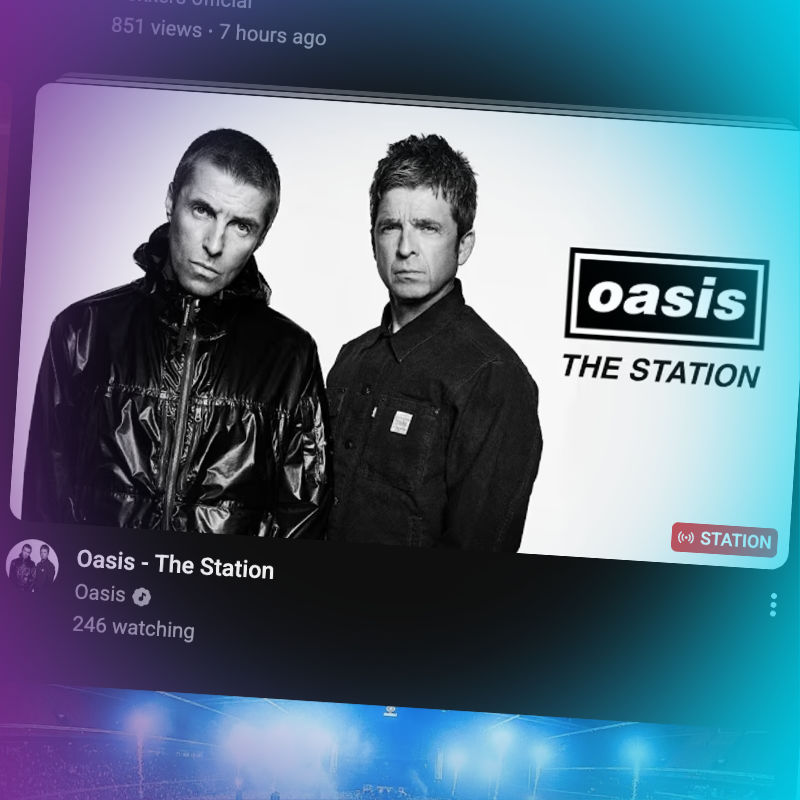
If you've noticed a "Station" badge on certain channels instead of the usual red "Live" badge, that's it. Stations turn a playlist of existing videos into a continuous 24/7 livestream.
Stations is invite-only with no public application process and no eligibility criteria. A number of major artist channels are currently running Stations, but access cannot be requested or planned around.
What YouTube Stations actually are
A YouTube Station is a livestream generated from a playlist of videos already on a channel. YouTube loops the playlist continuously, creating something that looks and behaves like a standard livestream: real-time playback, live chat, concurrent viewer count. Viewers can't skip tracks, rewind, or jump ahead. Everyone watches the same thing at the same time.
The interface is identical to a regular YouTube livestream with two differences. The red "Live" badge is replaced by a "Station" badge, and below the video player YouTube displays the title and artist name of the current track.
Why YouTube is doing this
YouTube has been investing heavily in live. At their Made on YouTube 2025 event, they announced dual-format streaming, React Live, AI-powered highlights, side-by-side ads, and practice mode. They called it the biggest update to Live they've ever made. Over 30% of daily logged-in YouTube viewers watched live content in Q2 2025.
Stations fits into this broader push. It extends live infrastructure to passive catalog listening. Two billion logged-in users consume music on YouTube every month, and YouTube paid $8 billion to the music industry between July 2024 and June 2025. Keeping listeners inside the ecosystem for longer sessions is a clear commercial priority.
The catalog angle matters too. According to Luminate's year-end data, catalog music accounts for over 73% of U.S. on-demand streaming. Labels are increasingly treating catalogs as active assets, and Stations gives catalog tracks persistent surface area they wouldn't get from algorithmic recommendations alone.
What Stations can't do
For labels evaluating Stations as a serious option, here's what's missing.
No audio-only content. Stations require existing YouTube videos. If your catalog is mostly audio-only releases (which is the case for most labels) those tracks can't be included.
No smooth transitions between songs. When one video ends, the next one starts after a noticeable gap. The listening experience breaks every few minutes.
Static, predictable playlists. A Station loops the same playlist in the same order every time. For anyone spending real time with the Station, it gets repetitive fast.
No visual customization. You see the existing music videos as uploaded. There's no way to add overlays, branding, track information beyond the basic title, or any visual identity to the Station. What's on your channel is what viewers see.
No fan interaction or campaigns. Standard YouTube live chat is there, but there are no chat commands, no way for fans to request streaming links to Spotify or Apple Music, no way to surface call-to-actions. You can't promote tickets, merchandise, pre-saves, or anything else within a Station. No QR codes, no clickable links in chat tied to the content playing, no promotional overlays.
No programming control. You can't schedule different content for different times of day or different days of the week. It's the same playlist, 24/7, on repeat.
No live source integration. You can't break into a Station with a live artist Q&A, a live performance, or any real-time content. The Station is automated playback of pre-existing videos, nothing more.
For a side-by-side comparison, see our dedicated page on YouTube Stations.
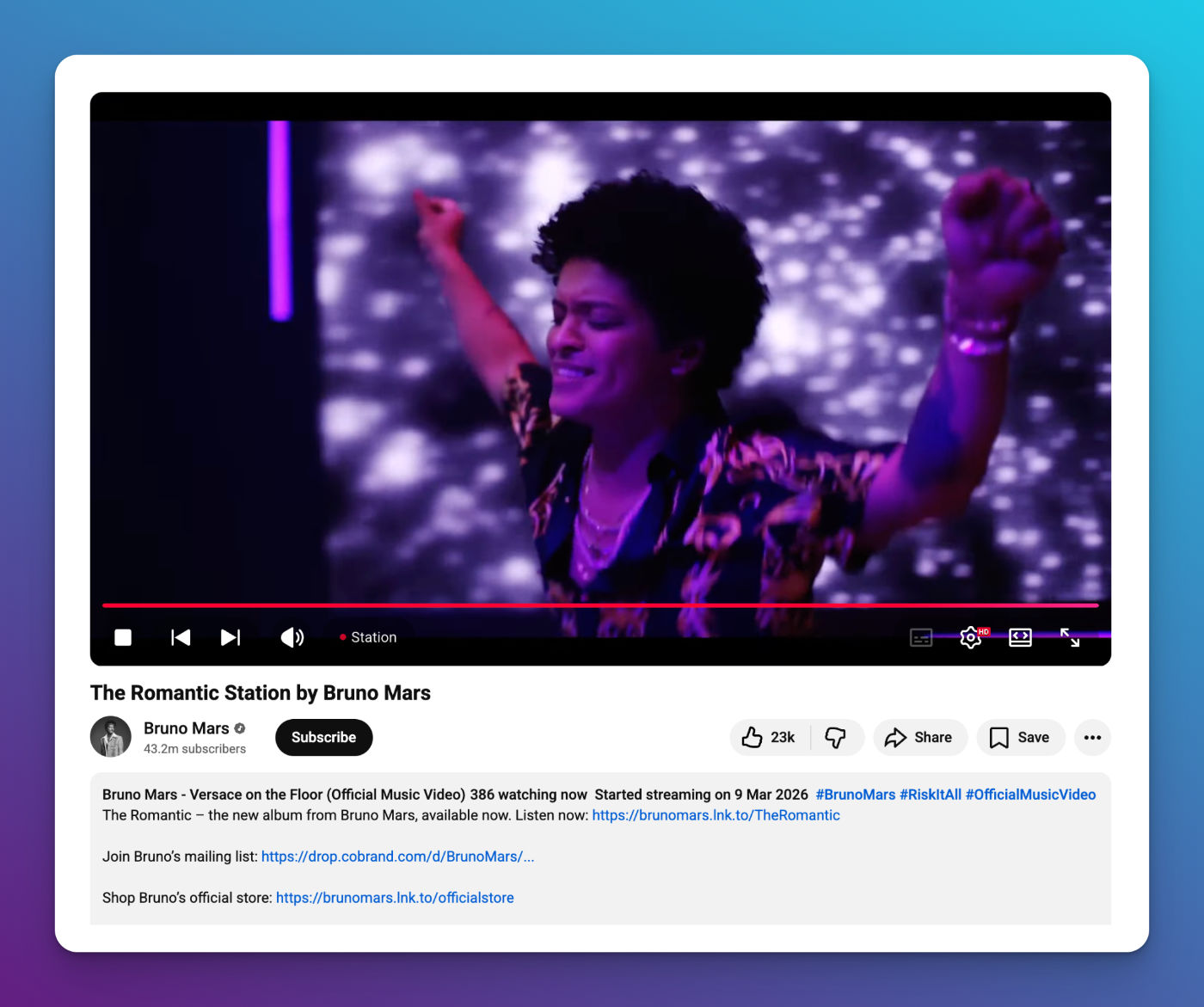
The Romantic Station by Bruno Mars
What a professional 24/7 channel can do instead
For music labels that want the benefits of an always-on YouTube presence but with actual control over programming, visuals, engagement, and monetisation, there are platforms built specifically for this.
StreamPush was built for the music industry and works differently from Stations in every area that matters for label operations: audio-only content with real-time visual generation, smooth transitions with harmonic matching, dynamic playlists that change every loop, full visual design control, fan chat commands for streaming links, campaign overlays with QR codes and click tracking, weekly broadcast scheduling, live source integration, DDEX catalog delivery, and configurable mid-roll ad insertion.
Audio-only content works. We generate real-time visuals from audio tracks using custom branded templates. This means you can include your entire catalog, not just tracks that have a music video on YouTube. For most labels, this opens up hundreds or thousands of tracks that would be excluded from a Station.
Smooth transitions between tracks. Your tracks are mixed with crossfades and harmonic matching (key and energy level), creating a continuous radio-like flow. No silence between tracks. No jarring stops and starts.
Dynamic playlists that change every loop. Instead of a static playlist, you can use smart track selection based on filters like genre, BPM, release date, artist, and custom tags. Every time a playlist cycles, the selection and order is different (for example, only tracks tagged 'high rotation' released in the past 6 months). It's also possible to sync playlists with Spotify playlists.
Full visual design control. You deliver a Photoshop design, and we transform it into a functional livestream template. Background images or video loops, dynamic track info, artist profile data (for example, social handles, profile pictures, QR codes), and campaign overlays can all be layered and positioned freely.
Chat commands for fans. We include a white-label chatbot that your viewers can use to get direct links to the currently playing track on Spotify, Apple Music, YouTube Music, SoundCloud, and other platforms. Spam detection works across the entire StreamPush network; one spammer blocked in any client's chat is blocked across all channels.
Campaigns that promote your catalog, releases, events, and merch. Campaigns are promotional overlays displayed on the livestream, triggered by specific content. For example, a festival ticket campaign can be linked to all performing artists' profiles, so it appears whenever those artists' tracks play. Campaigns can include QR codes on screen, clickable links posted by the chatbot, images, or video (with audio muted). Impressions and clicks are tracked per campaign.
Weekly broadcast scheduling. You get a full weekly calendar where you assign playlists to time slots. For example, you can run a deep house playlist during the evening, a vocal trance playlist on Saturday morning, a new releases block at noon. A default playlist fills any unscheduled time so the stream is never silent.
Live source integration. When an artist wants to do a Q&A, a live performance, or a studio session, we can switch the livestream from automated content to a live signal. When the session ends, regular programming resumes. Stream keys can be distributed to artists or media companies.
Catalog delivery via DDEX. We're connected as a DSP with distributors including FUGA, Sony Music, IDOL, Label Worx, Kontor New Media, rightsHUB, and AMPsuite. Delivering content works the same way as delivering to Spotify or Apple Music. Metadata comes in automatically, including cover art, release dates, genre, and ISRCs. BPM, musical key, and energy level are auto-detected.
Mid-roll ad automation. You can configure 0, 1, 2, or 3 mid-roll ads per hour via the YouTube API. This can also be managed through YouTube Studio.
Labels like Anjunabeats, Monstercat Silk, Nuclear Blast, Armada Music, and others have been running StreamPush-powered channels for years. Defected Records has been live 24/7 for multiple years with more than a million live views annually. Read our Case studies to learn more.
Who should use which
Stations may suit individual artist channels that already have a full catalog of music videos on YouTube and don't need programming control.
For music labels managing large catalogs across dozens or hundreds of artists — including audio-only releases — Stations doesn't cover what you need. No DDEX integration, no visual generation for audio content, no campaigns, and no programming schedule. And with access still invite-only, it's not something you can plan around.
If you want to treat your YouTube presence like a broadcast operation rather than a looping playlist, that's what StreamPush is built for. You can see how it works or compare platforms.
What happens next
YouTube Stations is invite-only with no public eligibility criteria, no application form, and no official documentation. Whether it opens up more broadly (and on what terms) is unknown. In its current form, it's a limited feature with significant gaps for anyone running a professional music channel. The labels already doing this properly can show you what the difference looks like.